

Silverado 2500 Duramax Diesel: Real-World Fuel Economy

The Silverado 2500 Duramax diesel does not have an official EPA fuel economy rating. Heavy-duty trucks are exempt from the fuel economy reporting requirements that apply to passenger vehicles and light-duty pickups, which means you will not find a government sticker number to compare. What you will find at McFarland Chevrolet in Maysville, KY is an answer based on what owners and operators actually report after putting real miles on this engine under real conditions. Caleb McFarland has driven a Silverado 2500 Duramax since he was a teenager. That is 20-plus years of personal data on one platform. This post gives you the real numbers, the variables that move them, and what the fuel economy actually means for your operating costs.
Why the 2500HD Duramax Has No EPA Fuel Economy Rating
This is the question most buyers hit first when they try to research 2500HD fuel economy and cannot find an official number.
The regulatory exemption for heavy-duty trucks
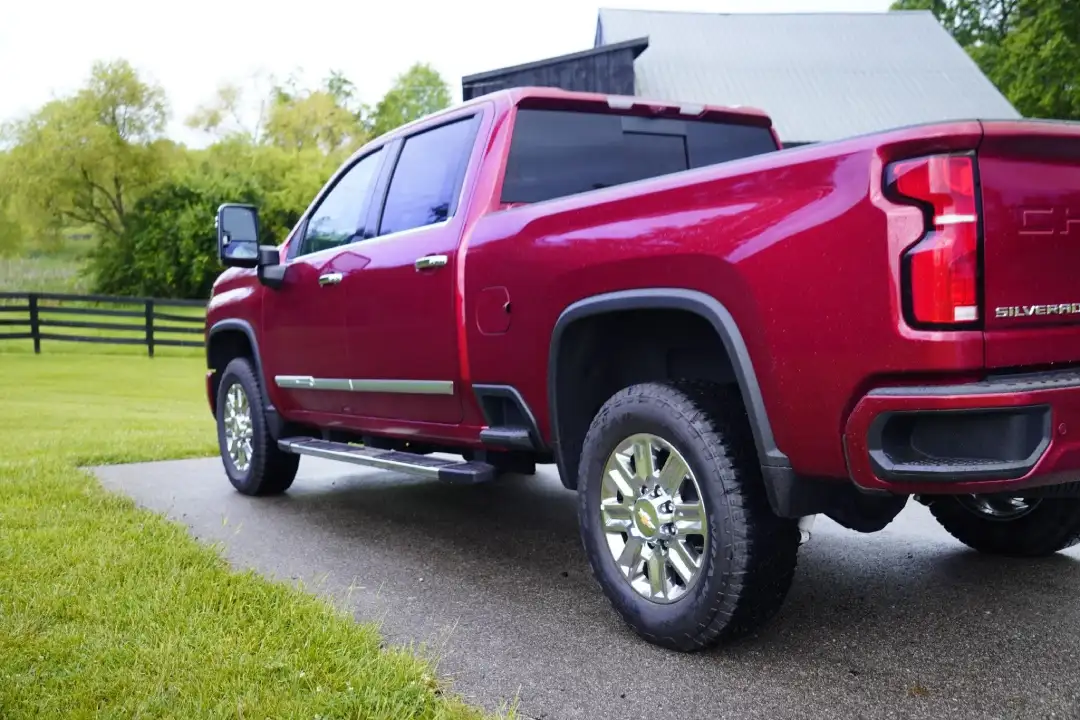
Federal fuel economy standards and testing requirements apply to vehicles with a Gross Vehicle Weight Rating (GVWR) under 8,500 lbs. The Silverado 2500HD has a GVWR in the 9,500 to 10,000 lb range depending on configuration, putting it above that threshold. This is why you see the familiar EPA MPG window sticker on a Silverado 1500 and no equivalent on a 2500HD. Chevrolet is not required to publish a fuel economy rating for the heavy-duty platform, and they do not.
Important note: Any website listing a specific combined EPA MPG for the Silverado 2500HD Duramax is either citing an unofficial estimate or repeating inaccurate information. There is no official EPA figure. Owner-reported data and manufacturer-published tow/haul fuel consumption figures are the only legitimate sources.
Real-World 2500HD Duramax Fuel Economy by Condition
Here is what owners actually report across different driving conditions. These figures represent the range across a large owner population and will vary based on factors covered in the next section.
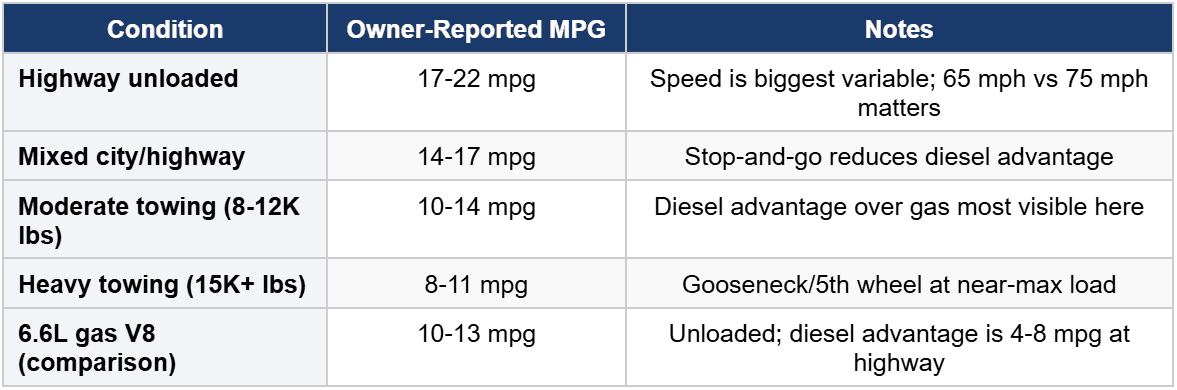
All figures are owner-reported. Individual results vary significantly based on speed, terrain, load, driving habits, and ambient temperature. The 6.6L gas V8 comparison row shows unloaded highway figures for context.
What Actually Moves the Fuel Economy Number
The range between 17 and 22 mpg for unloaded highway driving is wide enough to matter financially over a year. These are the variables that explain it.
View this post on Instagram
Speed: the single biggest factor
Aerodynamic drag increases with the square of speed. A large, heavy-duty pickup like the 2500HD experiences this more dramatically than a smaller vehicle. The difference between cruising at 65 mph and 75 mph on a steady highway run is often 2 to 3 mpg on the Duramax. Owners who drive 60 to 65 mph regularly report numbers at the upper end of the range. Owners who maintain 75 to 80 mph report numbers at the lower end. This is the single most controllable variable in your real-world fuel economy.
Terrain and grade
Fuel economy on a flat interstate is meaningfully better than on a rolling or hilly route. Buyers in Mason County and the surrounding Ohio Valley area know this terrain well. A run from Maysville to Lexington involves different fuel consumption than the same miles on flat ground. Grade climbing costs disproportionate fuel on a heavy vehicle. Grade descending recovers some through engine braking and coast, but the net effect of rolling terrain is reduced economy compared to flat highway.
Load weight
An empty 2500HD driving 70 mph on level interstate produces meaningfully better fuel economy than the same truck with a 10,000 lb trailer behind it. This should not be surprising but it is worth stating clearly: the Duramax’s fuel economy advantage over the gas engine grows most at moderate towing loads where the diesel’s low-RPM torque characteristics keep the engine in a more efficient operating range, and it shrinks somewhat at maximum load where both engines are working hard.
Cold weather and short trips
Diesel engines take longer to reach operating temperature than gasoline engines, which means short trips in cold weather produce disproportionately poor fuel economy. An owner making five-mile round trips in January will see much worse economy than one making 50-mile highway runs regardless of season. Buyers whose primary use is short daily trips in cold months will see real-world numbers well below the highway range cited above.
Pro tip: If you want to test your own truck’s highway economy accurately, do a full tank calculation over a minimum of 300 highway miles at your typical driving speed, starting and ending with a completely full tank at the same pump. Short-trip calculations are unreliable for establishing a true highway baseline.

Diesel vs Gas on the 2500HD: Does the Fuel Economy Actually Save Money?
The diesel gets better fuel economy than the 6.6L gas V8. The diesel also costs more to buy and diesel fuel often prices higher than regular unleaded. Whether the fuel economy advantage translates to net savings depends on your annual mileage and your typical driving profile.
The highway driving case
At 20,000 annual highway miles unloaded, the Duramax diesel might return 19 mpg while the 6.6L gas V8 returns 12 mpg. That is roughly 1,050 gallons for the diesel versus 1,667 gallons for the gas truck. At current fuel prices in Kentucky with diesel roughly $0.30 to $0.50 above regular unleaded, the diesel still saves meaningfully. At 20,000 highway miles the net fuel savings can reach $1,200 to $1,800 per year depending on price spreads. Over a five-year ownership period that adds up to $6,000 to $9,000 in fuel savings that can be weighed against the diesel option premium.
The towing case
The fuel economy gap between diesel and gas widens significantly when a trailer is attached. At moderate towing loads, the diesel’s advantage over the gas engine is its most pronounced. Buyers who regularly pull loaded gooseneck trailers or livestock haulers over long distances often find the diesel pays back its premium through fuel savings faster than pure highway driving calculations suggest. Full detail on the diesel vs gas decision is on our diesel vs gas trucks guide.
The short-trip case
For buyers who use the 2500HD primarily for short local trips, the diesel’s fuel economy advantage largely disappears. A diesel engine running cold on five-mile errands returns economy close to or even below the gas engine in that same scenario. The diesel’s efficiency advantage is a highway and sustained-load phenomenon. If your primary use is in-town driving with occasional trips of 30 miles or less, the diesel premium is harder to recover through fuel savings.
Additional question: Does the Duramax diesel pay for itself in fuel savings?
For buyers covering 15,000 or more highway miles annually, or who tow regularly over long distances, the diesel typically recovers its purchase premium within three to five years through fuel savings. For buyers with lower mileage or primarily city driving profiles, the payback period stretches beyond what most ownership periods justify. Run your own numbers using your actual annual highway mileage, your typical fuel price spread between diesel and regular, and the specific diesel option cost on the truck you are considering.

DEF Consumption and Its Effect on True Operating Cost
Diesel Exhaust Fluid is the one ongoing operating cost unique to the Duramax that affects the total fuel economy picture beyond just gallons of diesel burned.
What DEF consumption actually costs
The 6.6L Duramax consumes approximately one gallon of DEF per 1,000 miles driven. At current DEF pricing of roughly $3 to $4 per gallon, the annual cost at 20,000 miles is approximately $60 to $80. This is a real cost but a minor one relative to the fuel savings the diesel produces at that mileage level. DEF is available at most fuel stations, auto parts stores, and at the service counter. Running low on DEF generates a dashboard warning well before the system affects engine operation, and eventually the engine will limit power if DEF runs out entirely.
Pro tip: Keep a gallon of DEF in the bed of the truck if you regularly make long hauls. DEF is available almost everywhere, but having a backup on a remote route is the same common-sense planning you apply to any consumable. A gallon of DEF costs less than $5 and prevents any range anxiety about the DEF level on a long trip.
Two Decades of Real-World Data: Caleb’s 2006 Duramax
Most fuel economy discussions reference owner surveys or short-term test results. This one has a different data point.
The same truck, for 20 years
Caleb McFarland has driven a 2006 Silverado 2500 Duramax since he was a teenager. That truck is still his daily driver. Two decades of Duramax ownership in Mason County, covering the same routes in all seasons, provides a real-world longevity and efficiency picture that no brief road test delivers. The engine in the 2006 generation is different from the current L5P, but the fundamental Duramax characteristic of durable, sustained efficiency under load carries across every generation. The truck earns its fuel cost every day it works.
What long-term ownership teaches about fuel economy
Fuel economy on a well-maintained Duramax stays consistent at high mileage in a way that speaks to the engine’s design. Owners who maintain proper oil change intervals, fuel filter replacements, and clean injectors consistently report fuel economy figures in the ranges cited in this post even at 200,000 or 300,000 miles. The engine was built for sustained heavy-duty work over a long service life, and the fuel economy reflects that design intent.
What McFarland Recommends for Your Situation
McFarland Chevrolet has been family-owned in Maysville, KY since 1983. We sell and service the Silverado 2500HD Duramax to farmers, contractors, and working buyers across Mason County who depend on this platform. The right answer on diesel versus gas is not universal, and the fuel economy numbers above do not make the decision for you. They are the inputs. Your mileage, your load profile, and how long you plan to keep the truck are what determine whether the diesel’s fuel efficiency advantage justifies its additional cost.
Ready for Your Next Step?
Tell us your annual mileage and what you haul. We will walk through the fuel economy math with you before you commit to either engine. Call us at (606) 564-6181.
Also helpful:
Silverado 2500 6.6L Duramax engine page
2500HD towing capacity by engine
Diesel vs gas used trucks
Best Silverado 2500 for farm and ranch work
0 comment(s) so far on Silverado 2500 Duramax Diesel: Real-World Fuel Economy