

Best Three-Row Used SUVs for Large Families

Finding the best three-row used SUVs for large families comes down to more than seat count. Room for car seats, easy third-row access, and enough cargo space for the whole crew’s gear all matter as much as how many seats are on the spec sheet. This guide walks through what to look for, how the used Chevy Traverse fits large families, and when it makes sense to consider a bigger three-row option like the Tahoe or Suburban.
What to Look for in a Three-Row Used SUV for a Large Family
Seating capacity is the first number most shoppers check, but how those seats work day to day matters more. A third row that is hard to reach, or too tight for growing kids, gets used less than one built for real access.
Cargo space behind the third row matters as much as total seat count. A large family hauling backpacks, sports gear, and groceries needs room for all of it even with every seat filled.
Important note: A three-row SUV that seats eight on paper is only useful if the third row is easy for kids and adults to climb into. Always check third-row access in person before deciding based on the spec sheet alone.
Safety features are worth a close look too, especially on an SUV that will carry a full load of kids on a regular basis. Look for forward collision alerts, automatic emergency braking, and a rear seat reminder, since these features became more common across trims in recent model years.
Why the Chevy Traverse Is a Top Pick for Large Families
The Traverse is one of the most requested used SUVs on our lot, alongside the Blazer and Equinox. It offers real three-row space in a package that is easier to park and maneuver than a full-size SUV.
For families around Mason County juggling school runs, sports practices, and weekend trips to the Ohio River, that balance of space and size tends to matter more than chasing the biggest SUV available.
Seating and Cargo Room
Depending on the model year, the Traverse seats seven with second-row captain’s chairs, or eight with an available second-row bench. The third row splits 60/40, so you can fold one side for cargo while keeping a seat open for a passenger.
Room for Everyday Family Life
Behind the third row, there is enough space for backpacks, a diaper bag, and grocery bags without folding a seat. Fold the third row down, and the Traverse opens up to enough room for luggage on a family trip or a large haul from a store run.
For a large family juggling school drop-offs, sports practices, and weekend errands, that flexibility matters more than a single big number on a spec sheet. Fold only the third row for a sports equipment haul, or fold both rear rows for a bigger project, all without needing a second vehicle.
Pro tip: If you regularly carpool or haul a full third row of kids, look for a used Traverse with second-row captain’s chairs and SmartSlide access. It makes climbing into the third row easier without needing to fold the whole seat forward.
What Changes Between Used Traverse Generations
Chevy redesigned the Traverse for the 2024 model year, so used listings fall into two distinct generations. Knowing the difference helps you match the right year to your budget and priorities, rather than choosing based on model year alone.
2018 to 2023 Traverse
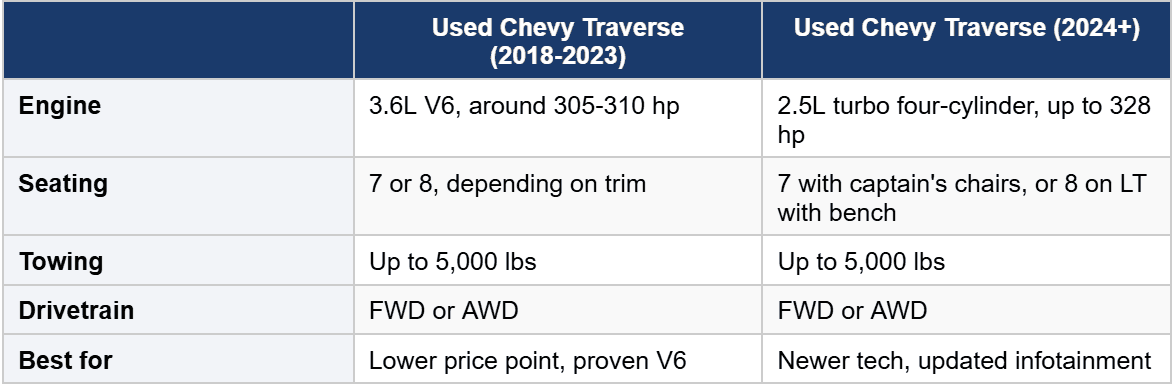
This generation runs a 3.6L V6 producing around 305 to 310 horsepower, with seating for seven or eight depending on trim. It is a proven engine with years of real-world ownership behind it, often available at a lower price point than the newer generation.
2024 and Newer Traverse
The redesigned Traverse swapped the V6 for a turbocharged 2.5L four-cylinder producing up to 328 horsepower, paired with an 8-speed automatic. It also brought a much larger touchscreen and updated driver assistance features standard across the lineup.
Additional question: Does the newer Traverse tow more than the older one? No. Both generations are rated to tow up to 5,000 pounds when properly equipped. The biggest differences are engine type, fuel efficiency, and interior technology.
Fuel economy is another factor worth comparing. The turbocharged four-cylinder in the redesigned Traverse was built partly to improve efficiency over the older V6, so a newer used Traverse may cost less to fill up over a large family’s typical week of driving, even though both engines handle daily hauling and towing duty well.
When to Consider Stepping Up to a Tahoe or Suburban
The Traverse covers most large families well, but some households need more. The Tahoe and Suburban are body-on-frame SUVs built on a truck platform, which means more cargo room, stronger towing, and a third row that sits higher off the ground.
Families who tow a camper or boat regularly, or who need maximum cargo room behind a full third row, are often better served by stepping up to one of these larger SUVs instead of a Traverse.
Important note: The Tahoe and Suburban ride and handle differently than the unibody Traverse, since they share a platform with the Silverado. Test drive both before deciding, since the difference is noticeable around town.
Parking and daily maneuvering are worth thinking through as well. A Tahoe or Suburban takes up more room in a garage or a school pickup line than a Traverse does, so the extra capability is worth weighing against how the SUV will be used most days, not only on the trips that need the extra room.
What to Check When Buying a Used Three-Row SUV
Once you know which model fits your family, a few checks help confirm you are getting a good one.
Third-Row Access and Comfort
Sit in the third row yourself, then have another adult try it too. What feels fine for a quick errand may not work for a longer drive with the whole family.
Maintenance History
Ask for service records, especially for transmission and cooling system maintenance. A documented history matters more on a family SUV that will be doing regular carpool and road trip duty.
On an older Traverse with the V6, ask about timing chain service and any transmission fluid changes. On a newer turbo four-cylinder model, ask whether it has stayed current with software and infotainment updates, since those SUVs rely more heavily on onboard technology.
Seating Configuration
Decide whether captain’s chairs or a bench seat fits your family better. Captain’s chairs make third-row access easier, while a bench seat adds one more seating position for a larger household.
Pro tip: Bring car seats or booster seats along on your test drive. Installing them yourself is the only real way to confirm they fit the way you need them to.
Used Traverse Generations at a Glance
Here is a quick side-by-side to help narrow down which generation fits your family and budget.
Find Your Family’s Next Three-Row SUV
Choosing between a used Traverse and a larger SUV like the Tahoe comes down to how your family actually uses a vehicle week to week, not only the numbers on a spec sheet.
Every used SUV on our lot goes through the same inspection process before it is offered for sale. Come see our current lineup of used Chevy Traverse models in Maysville, or compare the Traverse to the Tahoe to see which one fits your family best.
Wondering what your current vehicle is worth toward your next family SUV? Check your trade-in value, or call us at (606) 564-6181 to talk through which three-row SUV fits your family and your budget.
0 comment(s) so far on Best Three-Row Used SUVs for Large Families