

Chevy Silverado Towing FAQ
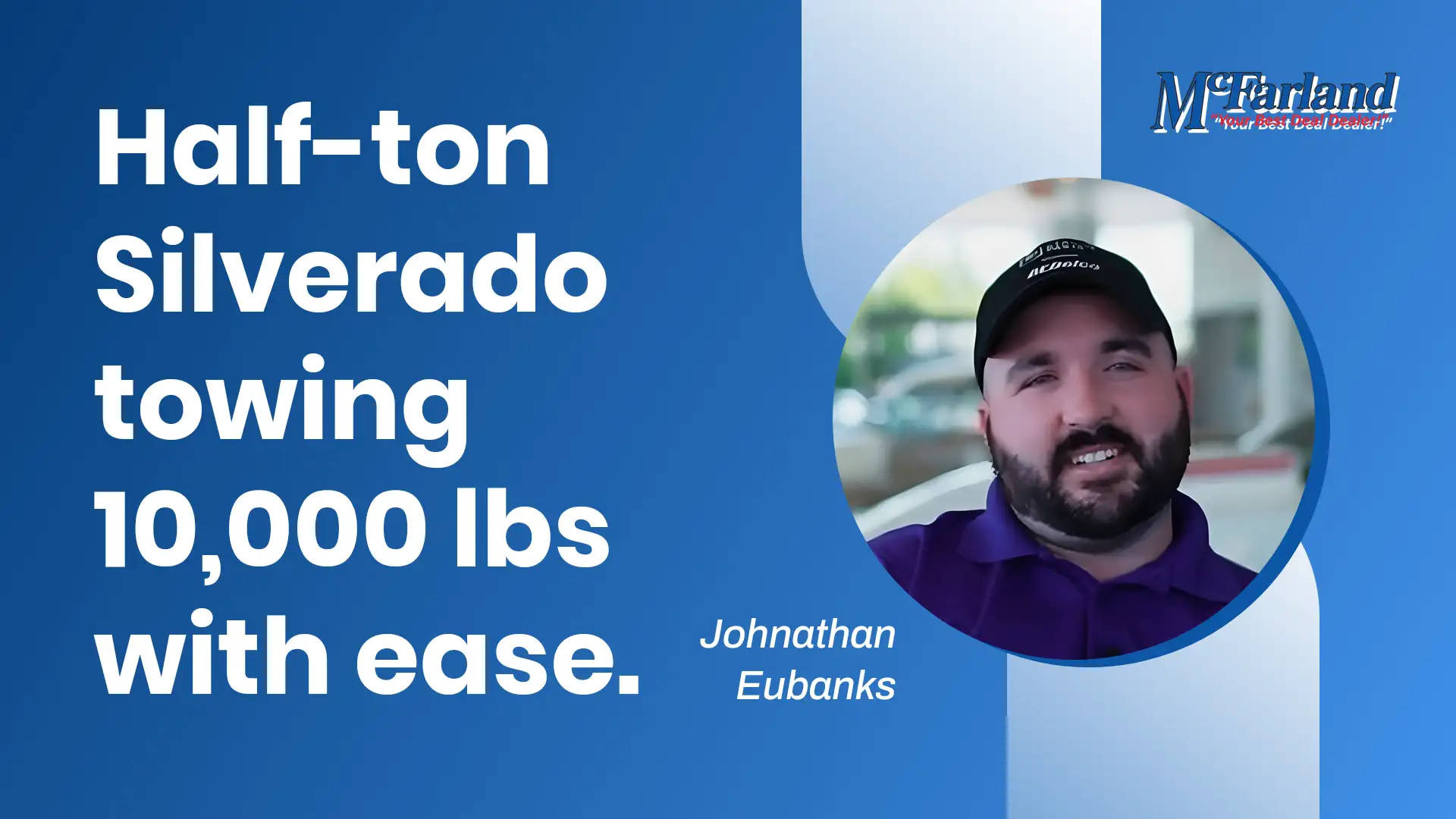
Towing questions deserve straight answers. In this FAQ, Service Manager and Silverado owner Johnathan Eubanks shares practical guidance earned from daily conversations in the service lane and from pulling heavy trailers himself. You’ll learn what affects towing capacity, which engines pair best with different kinds of loads, and why the 3.0L Duramax has become a favorite for combining confident pull with impressive efficiency. We’ll also cover real-world fuel economy while towing, the safety tech that makes trailering less stressful, and the maintenance steps that prevent costly failures after hard work. Whether you’re hauling equipment during the week or a camper on the weekend, use this guide to choose the right configuration, care for it properly, and tow with confidence.
FAQs
How much can a Silverado tow?
It depends on configuration: cab style, bed length, axle ratio, engine, and whether the truck includes a factory towing package. A properly equipped half-ton can tow a very substantial trailer, while HD models (2500/3500) are built for even bigger loads and fifth-wheel or gooseneck duty. The most important step is to check your specific truck’s door-jamb labels and the Owner’s Manual for its exact Gross Combined Weight Rating (GCWR), Maximum Trailer Weight, and tongue weight limits. Keep in mind that payload (people, gear, and hitch weight in the cab/bed) directly reduces available trailer capacity. When in doubt, weigh the truck and trailer at a public scale to confirm you’re within limits, and always use properly rated hitches, ball mounts, and brake controllers.
Which Silverado engine is best for towing?
“Best” depends on the kind of towing you do. For frequent highway towing in the half-ton, the 3.0L Duramax impresses because it pairs strong low-end torque with excellent real-world fuel economy and relaxed cruising. If you’re routinely near the upper end of 1500 tow ratings or in hilly terrain, a larger gas V8 or moving to a 2500 HD with a bigger engine can add headroom and braking confidence. Consider the full system: axle ratio, cooling package, integrated trailer brake controller, and mirrors. Johnathan’s rule of thumb: choose the engine that keeps RPMs calm at your typical towing speed, not just the one with the biggest brochure number. That balance usually delivers the safest, least stressful towing experience.
Is the 3.0 Duramax strong enough for farm work?
Yes—when matched to an appropriate trailer and within the truck’s ratings. Johnathan previously avoided the 3.0L diesel, then changed his mind after living with it: it tows with authority and returns excellent fuel economy doing real work. The key advantage is torque available at low RPM, which helps with rolling starts on gravel drives or backing a loaded trailer into a barn. Pair it with the right axle ratio and tow package, mind your payload and tongue weight, and you’ll have a quiet, confident setup for equipment, feed, or livestock tasks. If your loads consistently approach the top of the 1500’s range, step into a 2500 HD to gain cooling capacity, brakes, and frame strength designed for that duty cycle.
Can a half-ton Silverado tow a 10,000 lb trailer?
It can—if properly equipped and if 10,000 lbs sits within that specific truck’s certified maximum trailer rating and payload constraints. Johnathan’s own experience includes pulling a 10,000-lb dump trailer with a half-ton and noting the truck “didn’t even know it was there.” Real-world confidence like that comes from the right configuration: adequate axle ratio, factory tow package (for cooling and gearing), an integrated trailer brake controller, weight-distribution hitch when needed, and well-adjusted trailer brakes. Before you hook up, check the tongue weight (generally 10–15% for conventional towing) against your payload sticker. If the numbers work and the trailer is properly set up, a half-ton Silverado can tow 10K responsibly. If they don’t, choose a lighter trailer or move up to an HD.
How does towing affect fuel economy?
Expect lower MPG when towing—how much lower depends on speed, terrain, wind, and weight. Aerodynamics often matters more than raw mass; a tall boxy trailer can sap fuel economy faster than a compact equipment trailer of similar weight. This is where the 3.0L Duramax shines in a half-ton: diesel efficiency and low-RPM torque help keep consumption reasonable, especially at steady highway speeds. Helpful habits include using Tow/Haul mode, keeping tires at proper pressure (truck and trailer), staying at or below the speed where your combination feels planted, and avoiding sudden throttle inputs. Track your MPG with and without the trailer; if you see dramatic drops, look for dragging trailer brakes, underinflated tires, or unnecessary speed—fixes that can quickly save money.
What features help with towing safety?
Look for an integrated trailer brake controller, Tow/Haul mode, trailer sway control, and extendable/camera-equipped mirrors that improve visibility down the trailer’s sides. Modern Silverado trailering tech can add peace of mind with features like hitch guidance, checklist prompts, and multiple camera views to monitor cargo and lanes. A weight-distribution hitch with sway control can stabilize conventional trailers, and a properly set up gooseneck or fifth-wheel offers even greater stability for heavier loads. Safety still comes down to fundamentals: level the combination, set correct tire pressures for truck and trailer, verify working lights and breakaway cables, adjust trailer brakes to prevent push/pull sensations, and leave longer following distances—especially in crosswinds, rain, or downhill grades.
Do Silverados need special maintenance after heavy towing?
After hard towing, give the truck a quick post-trip check: tire pressures, lug torque (truck and trailer), brake pad life, and any unusual smells or noises from the transmission or driveline. Heat is the enemy; repeated heavy pulls speed up fluid degradation. Johnathan frequently sees expensive transmission problems tied to skipped fluid services—fluid turns dark and burnt, sometimes with metallic debris. If you tow regularly, start transmission service around 30,000 miles and repeat at sensible intervals. Don’t forget transfer case and differential fluids, plus brake fluid and coolant on schedule. Preventive maintenance is cheap insurance compared to downtime during planting, harvest, or a booked-up camping weekend.
Is diesel better than gas for Silverado towing?
It depends on your pattern. Diesel (like the 3.0L Duramax in the half-ton or the larger Duramax in HD models) brings strong low-RPM torque, engine-braking characteristics in the HD realm, and typically better MPG under load—great for frequent towing or long distances. Gas engines can be a better match for mixed use with lighter or occasional towing, lower up-front cost, and simpler fueling. Consider where you tow (mountains vs. flatland), how often, trailer aerodynamics, and idling needs. Many owners who tow weekly or haul heavy equipment find diesel pays back in fuel savings and reduced strain; others who tow a few weekends a year may prefer the simplicity of a gas V8. Match the engine to your real use, not a theoretical max.
How does Silverado compare to Ford/Ram for towing?
All three build capable trucks, and specific maximums shift by model year, axle ratio, and configuration. The meaningful differences most owners feel are confidence and control: how the truck manages heat on grades, stability in crosswinds, braking feel with a heavy trailer, and the usefulness of towing tech and cameras. Silverado focuses on a planted chassis, straightforward trailering features, and strong engine choices across half-ton and HD. Rather than chasing a brochure number, test the trucks you’re considering with your kind of trailer, at highway speeds and on familiar roads. The right choice is the one that tows your load calmly, keeps temps in check, and leaves you fresh at the end of the day.
What’s the best Silverado trim for farmers and haulers?
Start with crew cab if you carry people often, then pick the trim that offers the trailering gear you’ll actually use: integrated brake controller, advanced trailering package, cameras, and mirrors. If your days include gravel, gates, and fields, prioritize 4WD, skid plates, recovery hooks, and a bed/liner setup that survives straps and chains. For frequent heavy towing, consider an axle ratio geared for pulling rather than pure highway MPG. If your loads routinely push the top of 1500 limits, step into 2500 HD for bigger brakes, cooling, and frame capacity. The “best” trim is the one that equips you for your weekly reality—moving equipment, hay, campers, or boats—while keeping the cab comfortable for long days.
Conclusion
Silverado offers a broad, flexible towing lineup—across engines, gears, and packages—so you can tailor a truck to the work and weekends you actually have. The 3.0L Duramax stands out in the half-ton for its blend of calm torque and impressive fuel economy, while HD models add the cooling, braking, and structure for serious weight and long grades. Real-world experience matters more than one top-line spec, which is why Johnathan’s perspective resonates: choose a configuration that tows steadily at your speed, on your roads, with your kind of trailer. Do that—and stick to smart maintenance—and you’ll get the capability you need without drama, mile after mile.
Visit McFarland Chevy
Schedule a trailering test drive and get your trade-in value instantly. We’ll help you choose the right Silverado configuration, set up your hitch and brake controller, and make sure you’re tow-ready from day one.
0 comment(s) so far on Chevy Silverado Towing FAQ