

Silverado 2500 vs Ford F-250
Silverado 2500 vs Ford F-250
Shoppers comparing the Silverado 2500 vs Ford F-250 are usually chasing one of a few answers: which engine makes more power, which truck can tow and haul more, and which one is the better long-term value.
This page walks through the honest side-by-side, using verified specs for both trucks, rather than picking only the numbers that favor one brand.
We sell and service Chevrolet at McFarland, so we naturally think the Silverado 2500HD is the right choice for most of our customers. Ford’s F-250 is also a genuinely strong truck, and on several headline numbers, it currently leads the segment. We would rather tell you that directly than pretend otherwise.
Below, we compare engines, towing and payload, transmission and suspension, real-world ownership, and trim lineups using verified specs for both trucks, then break down which buyer tends to be happier with each one.
Engines: Gas V8 and Diesel Compared
Both trucks offer a gas V8 and diesel option, and Ford currently holds an edge on raw output across the board.
Gas V8: L8T vs 7.3L V8
The Silverado’s 6.6L L8T V8 produces 401 horsepower and 464 lb-ft of torque. Ford’s 7.3L gas V8 produces 430 horsepower and 485 lb-ft of torque, giving the F-250 an edge in both categories on paper.
For buyers who tow only occasionally and want to avoid diesel maintenance costs, either gas V8 covers most daily work without the added expense of the diesel upgrade on either truck.
Diesel: Duramax vs High-Output Power Stroke
The Silverado’s 6.6L Duramax (L5P) produces 470 horsepower and 975 lb-ft of torque, built at Flint Engine Operations. Ford’s 6.7L High-Output Power Stroke produces 500 horsepower and 1,200 lb-ft of torque, a meaningful lead on both figures.
Ford also offers a standard-output Power Stroke diesel below the High-Output version, which narrows the gap somewhat for buyers who do not need the absolute peak numbers the High-Output engine offers.
Important note: Ford currently advertises the highest gas and diesel horsepower and torque figures in the heavy-duty segment. That lead is real, and it shows up most clearly in outright towing and payload ceilings, covered next.
Towing and Payload
This is the category where Ford’s engine advantage translates most directly into a real-world gap.
Both brands advertise their single highest achievable rating prominently, which almost never matches the specific truck sitting on a lot. The only fair way to compare is cab to cab, bed to bed, and engine to engine.
The 2026 Silverado 2500HD is rated to tow up to 18,500 pounds with the Duramax diesel and the gooseneck or fifth-wheel prep package installed. Ford’s F-250 is rated up to 23,000 pounds with the High-Output Power Stroke and its own gooseneck towing package, a notably higher ceiling.
Payload follows a similar pattern. Ford’s 7.3L gas V8 reaches a maximum payload of 4,246 pounds, ahead of the Silverado 2500HD’s maximum payload of 3,979 pounds.
For most buyers, the practical question is not which truck’s absolute ceiling is higher, but whether either truck’s realistic configuration comfortably covers what you actually haul week to week. Both trucks handle the large majority of real-world towing and hauling jobs without approaching their limits.
Important note: Both trucks’ towing and payload ratings vary substantially by cab style, bed length, axle ratio, and drivetrain. A specific Silverado configuration can still out-tow or out-haul a specific F-250 configuration depending on how each is built, so compare actual builds rather than only the advertised maximums.
Trims and Features
Both trucks span a similar range from work-focused base trims to premium, comfort-oriented top trims.
The 2026 Silverado 2500HD lineup runs from the work-focused WT through Custom, LT, LTZ, the off-road ZR2, and the premium High Country. Ford’s F-250 lineup runs from the work-focused XL through XLT, Lariat, King Ranch, and Platinum, with the off-road Tremor package available on select trims.
Both brands also offer factory off-road-oriented options aimed at buyers who need rough-terrain capability without giving up heavy-duty towing entirely, the ZR2 on the Chevy side and the Tremor package on the Ford side.
Pro tip: Match trims by role rather than by name. A Silverado LTZ and an F-250 King Ranch serve a similar comfort-focused buyer, even though the trim names do not line up one to one across the two brands.
Transmission and Suspension
Away from the engine bay, the two trucks share more in common than the spec sheet rivalry suggests.
Transmission
Both trucks pair their engines with a 10-speed automatic transmission tuned for towing, with tow/haul modes designed to manage shift points and engine braking under heavy load.
Neither transmission is a clear step down from the other in day-to-day use. Both are mature designs with years of heavy-duty service behind them across their respective lineups.
Rear Suspension
Both the Silverado 2500HD and the Ford F-250 use a leaf-spring rear suspension, which favors stability under heavy, consistent loads. This is a point of similarity between the two, in contrast to Ram’s coil-spring setup on the 2500.
If ride quality under load is a top priority, this similarity matters more than either brand’s marketing suggests. The bigger ride difference in this class shows up when comparing either truck against Ram, not against each other.
Pro tip: If you are cross-shopping all three domestic heavy-duty trucks, Chevy and Ford ride more similarly to each other loaded down than either does to Ram, which matters if ride comparisons are part of your decision.
Real-World Ownership
Spec sheets settle arguments online, but ownership experience is what actually matters after the sale.
Silverados showing up on trade-in with 300,000 to 500,000 miles of use are not unusual at our dealership, and several members of our own sales team drive Duramax-powered Silverados as personal daily trucks, including a 2006 model still in daily use.
That kind of long-term ownership story is not a substitute for independent lab testing, but it reflects what actually comes through our service department and trade-in lot week after week, which counts for something a spec sheet cannot capture.
Additional question: Does Ford’s horsepower and towing lead mean it is the better truck overall? Not necessarily. For buyers who regularly need the absolute maximum tow rating, Ford’s numbers are worth taking seriously. For buyers whose daily use sits well under either truck’s maximum, long-term ownership experience and service relationship often matter more than the number on the window sticker.
Which Truck Fits Your Needs
Both trucks are capable, well-engineered heavy-duty options. The honest answer depends on what you actually need most.
Choose the Silverado 2500HD If…
Your towing and payload needs sit comfortably under 18,500 pounds and 3,979 pounds, you want a truck backed by a dealer who can service it locally for years to come, or you value the ownership experience our customers report over time.
Buyers who tow a few times a month rather than daily, and who care more about a trusted long-term service relationship than chasing the highest number in the segment, tend to be well served by the Silverado 2500HD.
Consider the Ford F-250 If…
You need the highest available towing or payload ceiling in the segment, your work regularly pushes close to a heavy-duty truck’s absolute maximum ratings, or the extra horsepower and torque headroom matters for your specific hauling needs.
Buyers who consistently haul near the top of what a heavy-duty truck can handle, such as large fifth-wheel RVs or commercial equipment trailers, are the ones most likely to actually use Ford’s extra headroom rather than carry it as an unused number.
Ownership and Service Considerations
Specs matter on the day you buy a truck. Service and support matter for every day after that.
Parts and Service Access
As a Chevrolet dealer, our GM-certified technicians work on Silverados daily and have access to GM’s specific tools, training, and parts supply chain. That familiarity adds up over years of oil changes, repairs, and warranty work.
This is less about either brand’s engineering and more about which shop you will actually be walking into for the next decade of maintenance. A truck you trust is also a truck whose dealer you trust to keep it running.
Trade-In and Resale
A documented service history with the same dealer that sold the truck tends to support a stronger trade-in appraisal down the road, regardless of which brand you choose. This is worth factoring in alongside the spec sheet, since most truck owners eventually trade in or sell.
Consistent maintenance records matter to the next buyer too, whether that is a private sale or a trade toward your next truck. A gap-free history is worth as much as the brand name on the tailgate in many resale conversations.
Important note: The Silverado 2500HD is assembled at Flint Assembly in Flint, Michigan. We are a Chevrolet dealer, so we can service and support a Silverado for the long haul in a way we cannot for a Ford.
Silverado 2500HD vs Ford F-250 Quick Reference
Here is a side-by-side look at the verified specs covered above.
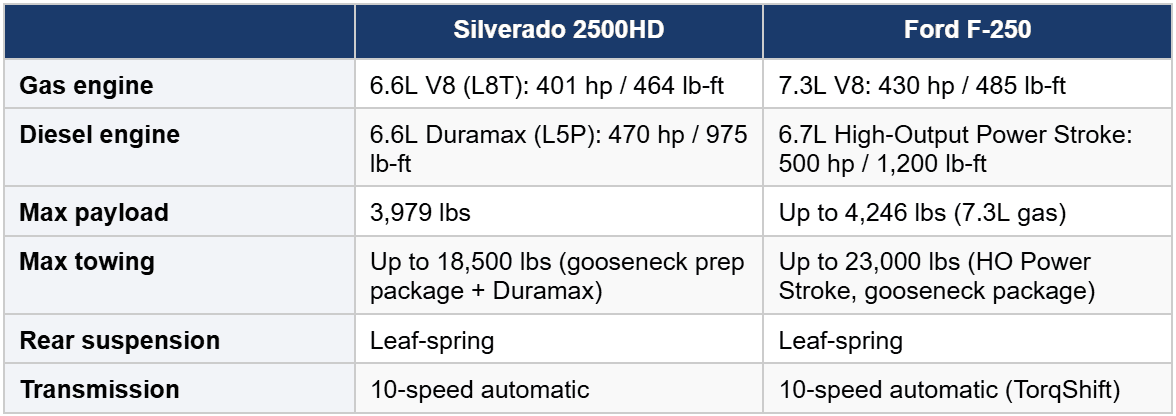
Ford’s F-250 leads on several headline numbers in this comparison. Whether that lead matters for your day-to-day use is worth weighing honestly against the ownership experience and service relationship that come with either truck.
See the Silverado 2500HD in Person
Numbers on a page only tell part of the story. Come see our current lineup of new Silverado 2500HD trucks in Maysville and decide for yourself how it fits your needs.
For the full towing and payload breakdown, visit our Silverado 2500 towing and capability page, or see how the 2500HD fits work and contractor use. Check your trade-in value, or call us at (606) 564-6181 to talk through the right heavy-duty truck for your needs.