

Chevy Trax Fuel Economy: What MPG to Expect by Year and Engine

Chevy Trax fuel economy is one of its strongest selling points and one of the most-asked questions at McFarland Chevrolet in Maysville, KY. The 2026 Trax gets up to 28 mpg city and 32 mpg highway, making it one of the most fuel-efficient gas-powered vehicles in Chevrolet’s entire lineup. This post covers the actual MPG numbers for the current Trax and for every generation going back to 2013, explains what the 2023 redesign changed, and answers the real-world fuel economy questions buyers search most.
How Many MPG Does the 2026 Chevy Trax Get?
The 2026 Chevy Trax is EPA-rated at 28 mpg city and 32 mpg highway with the standard front-wheel drive configuration. All-wheel drive is not available on the Trax, so every 2026 model returns these figures.
What drives those numbers
The Trax uses a 1.2L turbocharged 3-cylinder engine producing 137 hp and 162 lb-ft of torque, paired to a continuously variable transmission. The 3-cylinder configuration and light vehicle weight are the primary reasons the Trax achieves fuel economy that most compact SUVs do not match. The small displacement engine works harder than a larger engine at highway speeds, but the CVT keeps it in an efficient RPM range for most driving conditions.
Real-world vs EPA estimates
EPA estimates are a useful comparison benchmark but real-world numbers depend on how and where you drive. Highway-focused drivers who primarily cruise at moderate speeds can expect results close to or at the 32 mpg estimate. Buyers who drive primarily in city and suburban stop-and-go conditions will see numbers closer to the 28 mpg city figure. Mixed driving typically lands between the two, around 29 to 31 mpg for most buyers in everyday use.
How many MPG does a Chevy Trax get?
The 2026 Chevy Trax is EPA-rated at 28 mpg city and 32 mpg highway. All configurations are front-wheel drive with a 1.2L turbocharged 3-cylinder engine and CVT transmission. Real-world mixed driving typically returns 29 to 31 mpg for most buyers.
Is the Chevy Trax good on gas?
Yes. The Trax is one of the most fuel-efficient gas-powered vehicles in Chevrolet’s lineup. At 28 city and 32 highway, it matches or beats many hybrid compact cars and outperforms larger compact SUVs like the Equinox on raw MPG numbers. For buyers whose primary use is commuting and daily errands, fuel costs on the Trax are meaningfully lower than most alternatives.
Chevy Trax MPG by Year: Every Generation at a Glance
Here are the EPA fuel economy ratings across every Trax generation for buyers researching specific model years.
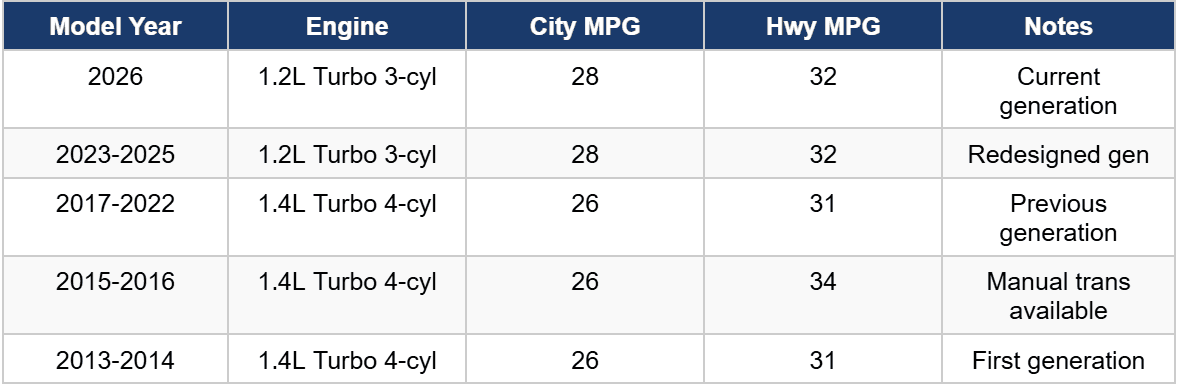
Figures are EPA estimates for the most common configuration in each model year. The 2015-2016 manual transmission models had slightly higher highway ratings. Actual results vary by trim, configuration, and driving conditions.
What MPG does the 2023 Chevy Trax get?
The 2023 Chevy Trax was a complete redesign. It uses the 1.2L turbocharged 3-cylinder and is EPA-rated at 28 mpg city and 32 mpg highway, the same as the current 2026 model. The 2023 is when the fuel economy improved over the previous generation’s 26/31 ratings.
What MPG does the 2020 Chevy Trax get?
The 2020 Trax uses the previous-generation 1.4L turbocharged 4-cylinder and is EPA-rated at approximately 26 mpg city and 31 mpg highway. This is the same engine and rating as the 2017 through 2022 models. The 2023 redesign brought a meaningful improvement.
What MPG does the 2018 Chevy Trax get?
The 2018 Trax is rated at approximately 26 mpg city and 31 mpg highway. It uses the 1.4L turbocharged 4-cylinder with a 6-speed automatic. Fuel economy on the 2017 through 2022 generation is consistent across those years.
What the 2023 Redesign Changed for Fuel Economy
The 2023 redesign was the most significant update in the Trax’s history and it improved fuel economy while also increasing power and redesigning the interior.
New engine: smaller displacement, better results
The previous generation Trax used a 1.4L turbocharged 4-cylinder. The 2023 redesign switched to a 1.2L turbocharged 3-cylinder. Fewer cylinders and smaller displacement sounds like less truck, but the new engine produces 137 hp compared to the old engine’s 155 hp, and the torque output and real-world efficiency improved. The 3-cylinder is lighter and more efficient and the CVT transmission manages its output better than the old 6-speed automatic at most driving speeds.
The 3-cylinder question buyers always ask
Buyers who have never owned a 3-cylinder often worry it will feel underpowered. In the Trax, that concern is misplaced. The turbocharged 3-cylinder delivers its torque in a way that feels responsive in everyday driving. The Trax is not a performance vehicle, but it merges onto highways, pulls into gaps in traffic, and carries passengers without laboring. The fuel economy is the payoff for the smaller displacement, and it is a real and consistent payoff.
Is the 2023 Chevy Trax more fuel efficient than older models?
Yes. The 2023 redesign improved highway fuel economy from approximately 31 mpg to 32 mpg and city fuel economy from 26 to 28 mpg compared to the 2017-2022 generation. The new 1.2L 3-cylinder and CVT transmission are more efficient than the previous 1.4L 4-cylinder and 6-speed automatic.
Does the Chevy Trax have a 3-cylinder engine?
Yes, starting with the 2023 redesign. The current Trax uses a 1.2L turbocharged 3-cylinder producing 137 hp and 162 lb-ft of torque. The previous generation (2017-2022) used a 1.4L turbocharged 4-cylinder. The 3-cylinder is quieter, lighter, and more efficient than buyers typically expect.
What Actually Affects Your Trax’s Real-World Fuel Economy
The EPA numbers are what you can expect under optimal conditions. These are the factors that move your real-world results above or below those estimates.
Driving pattern is the biggest factor
Highway cruising at steady speeds is where the Trax returns its best fuel economy. Stop-and-go city driving is where it sees its lowest results. If your daily drive is mostly highway miles at 55 to 65 mph, you will frequently see numbers near or above the 32 mpg estimate. If you spend most of your time in urban traffic, expect results in the 27 to 29 mpg range. Mixed suburban driving typically lands around 29 to 31 mpg.
Cold weather reduces fuel economy on any vehicle
Fuel economy on the Trax drops in cold temperatures, as it does on every vehicle with a gasoline engine. Cold starts require more fuel to warm the engine and emissions systems to operating temperature. Short trips in winter where the engine never fully warms up are the worst-case scenario for fuel economy. Buyers in the Maysville area who make mostly short winter trips should expect real-world MPG below EPA estimates during those months.
Tire pressure and maintenance matter
Under-inflated tires increase rolling resistance and reduce fuel economy. A Trax running 5 psi below the recommended pressure loses a meaningful fraction of its efficiency. Keeping tires at the manufacturer-specified pressure is one of the simplest ways to preserve real-world MPG. A clean air filter and fresh oil at the correct interval also contribute to efficiency. At McFarland, every oil change includes a tire rotation and all fluid checks, which keeps these items current.
Why is my Chevy Trax getting bad gas mileage?
The most common causes of lower-than-expected fuel economy on a Trax are: primarily city and stop-and-go driving, cold weather and short trips, under-inflated tires, a dirty air filter, or deferred oil changes. If you are seeing numbers significantly below EPA estimates and your driving pattern is mainly highway, a service check is worthwhile to rule out engine or sensor issues.
Is the Chevy Trax fuel efficient?
Yes. The 2026 Trax at 28 city and 32 highway is competitive with fuel-efficient compact cars, not just SUVs. For a vehicle that offers the practicality of a subcompact SUV, the active safety features of a modern Chevrolet, and full infotainment connectivity, the fuel economy is a genuine strength and not a trade-off.
Trax vs Equinox Fuel Economy: What the Difference Means in Practice
The Trax and Equinox are both Chevrolet SUVs and both are fuel efficient, but buyers cross-shopping the two should understand where the numbers actually sit.
The Equinox FWD also gets 28/32
The 2026 Equinox with the standard 1.5L turbocharged 4-cylinder and front-wheel drive is also EPA-rated at approximately 28 mpg city and 32 mpg highway. On paper the two vehicles match. In practice, a lighter Trax driven on an identical route will occasionally return slightly better real-world economy, but the difference is not meaningful in everyday use. The Equinox AWD drops to approximately 26/29, which is where the Trax genuinely pulls ahead for buyers comparing AWD configurations.
The real difference is size and price, not fuel economy
If fuel economy is the primary reason you are considering the Trax over the Equinox, the FWD Equinox matches it. The Trax’s advantages over the Equinox are price and size: it is less expensive, easier to park, and better suited to single drivers and small families who do not need the Equinox’s additional space. The choice between the two should be driven by size and budget needs, not fuel economy. Our Trax buyer’s guide covers that comparison in detail.
Does the Trax get better gas mileage than the Equinox?
On FWD configurations, the Trax and Equinox are rated essentially the same at approximately 28 city and 32 highway. The Trax does not have an AWD option, so it maintains that rating across all configurations. The Equinox AWD drops to approximately 26/29. If you are comparing AWD Equinox to the FWD Trax, the Trax has a meaningful efficiency advantage.
The Chevy Trax at McFarland Chevrolet
McFarland Chevrolet has been family-owned in Maysville, KY since 1983. The Trax is one of our top-selling vehicles because it fits what a lot of buyers in this area are looking for: a dependable, practical vehicle with low fuel costs at a price that works.
Service keeps those numbers where they should be
Keeping a Trax at its EPA potential over time is simple: regular oil changes, clean air filter, correct tire pressure. At McFarland, every oil change includes a tire rotation, all fluid checks, and a complimentary car wash. We are open Saturdays. Buyers who service with us have their full vehicle history on file, which helps at trade-in time.
Where can I buy a fuel-efficient Chevy Trax near Maysville, KY?
McFarland Chevrolet in Maysville, KY carries 2026 Chevy Trax models in all four trims: LS, LT, ACTIV, and RS. Call us at (606) 564-6181 to check current inventory.
Ready for Your Next Step?
If you want to see what real-world Trax fuel economy looks like on a test drive around Maysville, come in and find out. Call us at (606) 564-6181.
Also helpful:
Chevy Trax buyer’s guide
Trax trim comparison: LS vs LT vs ACTIV vs RS
Chevy Equinox fuel economy guide
Service your Trax at McFarland
0 comment(s) so far on Chevy Trax Fuel Economy: What MPG to Expect by Year and Engine