

Chevy Silverado vs Ford F-150: Honest Comparison
Chevy Silverado vs Ford F-150: Honest Comparison
The Chevy Silverado vs Ford F-150 comparison is the most researched decision in the full-size truck segment. These are the two best-selling trucks in the country and they are genuinely close in most categories. At McFarland Chevrolet in Maysville, KY, we sell Silverados.
We are straightforward about that. We are also straightforward about what the comparison actually looks like across the categories that matter to real buyers. This page covers the 2026 Silverado and F-150 across engines, towing, payload, reliability, interior, and the specific areas where each truck has a genuine advantage.
Silverado vs F-150: At a Glance
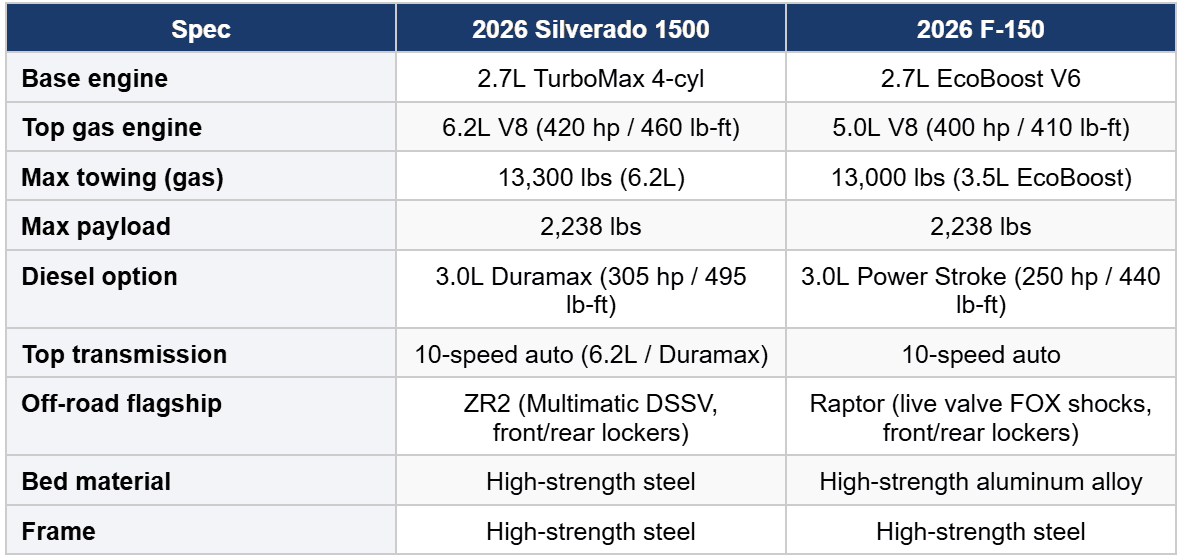
Here is a side-by-side comparison of key specs for the 2026 models.
Engines: Two Different Approaches to the Same Problem
Both the Silverado and the F-150 offer turbocharged 4-cylinder engines as their base option, V8 engines in the middle, and diesel options at the top. The philosophies are different.
Base engine: The Silverado uses a 2.7L TurboMax inline-4. The F-150 uses a 2.7L EcoBoost V6. Both are turbocharged and both produce competitive output. The F-150’s base engine is a 6-cylinder, which some buyers prefer on principle. The Silverado’s inline-4 produces 310 hp and 430 lb-ft of torque, which is competitive with the EcoBoost V6. In practice, the two engines deliver a similar everyday driving experience in their respective trucks.
V8: The Silverado’s 6.2L V8 produces 420 hp and 460 lb-ft of torque. The F-150’s 5.0L V8 produces 400 hp and 410 lb-ft of torque. The Silverado has a meaningful power advantage in the V8 category. The 6.2L is also paired to a 10-speed automatic, which is the same transmission tier as the F-150’s 10-speed. The Silverado’s V8 is the stronger engine and it produces more towing capacity as a result.
Turbocharged V6 (F-150 3.5L EcoBoost): This is an important category where the F-150 has a specific advantage worth naming. The F-150’s 3.5L EcoBoost V6 is a widely respected engine that produces 400 hp and 500 lb-ft of torque and enables the F-150’s maximum towing rating of 13,000 lbs. It also has a PowerBoost hybrid version. The Silverado does not have a comparable turbocharged V6 option. Buyers who specifically want a high-output turbo V6 are better served by the F-150 in that engine category.
Diesel: The Silverado’s 3.0L Duramax produces 305 hp and 495 lb-ft of torque. The F-150’s 3.0L Power Stroke produces 250 hp and 440 lb-ft of torque. The Silverado’s diesel is the stronger engine in both horsepower and torque. The Silverado diesel also delivers better real-world highway fuel economy. For buyers whose primary reason for choosing diesel is fuel efficiency and low-end torque, the Duramax wins this category directly.
Towing Capacity: Very Close at the Top
The maximum towing figures for both trucks are within 300 lbs of each other at the top.
The 2026 Silverado 1500 can tow up to 13,300 lbs with the 6.2L V8 when properly equipped. The 2026 F-150 reaches up to 13,000 lbs with the 3.5L EcoBoost V6. In practical terms, this difference is not meaningful. Both trucks can handle the same real-world load. The question of which truck tows better is not answered at the maximum figure. It is answered in how each truck manages load stability, brake performance, and powertrain confidence under sustained towing.
The Silverado’s diesel tows up to 9,500 lbs, lower than the gas V8 options. The F-150 diesel is rated at 11,500 lbs, giving the F-150 diesel a towing advantage over the Silverado diesel. For buyers who specifically want diesel towing above 9,500 lbs, the F-150 diesel is the stronger choice in that specific configuration.
For complete towing numbers by engine and configuration on the Silverado, see our Silverado towing capacity page.
Payload Capacity: Effectively Equal
The maximum payload ratings for both trucks are essentially the same at 2,238 lbs on the Silverado and comparable figures on the F-150 depending on configuration. Neither truck has a meaningful payload advantage over the other. The specific payload for any individual truck is on the door jamb sticker, which varies by configuration regardless of which brand is on the badge.
Bed Construction: Steel vs Aluminum
This is one of the more discussed differences between the two trucks and it is worth an honest explanation.
The F-150 uses a high-strength aluminum alloy bed. Ford made this change with the 2015 redesign and has maintained it through the current generation. Aluminum is lighter than steel, which contributes to the F-150’s fuel economy and helps offset the weight of the aluminum bed in the overall truck mass. The F-150’s aluminum bed does not dent in quite the same way steel does but it can crack under impact and aluminum repairs are typically more expensive than steel repairs.
The Silverado uses a high-strength steel bed. Steel dents differently than aluminum. Minor dents in a steel bed can often be straightened where aluminum requires more involved repair. Steel is heavier than aluminum but the Silverado’s bed is engineered for durability under heavy use. For buyers who load and unload heavy materials frequently, or who work with equipment that makes contact with the bed walls, the steel bed’s damage characteristics are more predictable and typically less expensive to address.
This is not a clear winner in either direction. Buyers who load light materials and prioritize fuel economy may prefer the F-150’s aluminum. Buyers who use the bed hard and want predictable, affordable repairs tend to prefer the Silverado’s steel. Neither bed is fragile when used correctly with a proper bed liner.
Silverado vs F-150 Reliability: What the Data Shows
Reliability is the question that buyers searching this comparison care about most based on the keyword data. Here is an honest answer based on available data rather than brand loyalty.
Both trucks have strong long-term reliability records. Both have accumulated millions of miles of documented real-world use across multiple generations. Owner reports of 200,000-plus miles on well-maintained examples are common on both platforms. The reliability difference between the two is not dramatic for buyers who maintain their trucks properly.
Where the Silverado has a specific documented reliability advantage: the 5.3L and 6.2L V8 engine generations have accumulated more long-term mileage data than the F-150’s EcoBoost engines, which are newer to the market. The Silverado’s naturally aspirated V8 engines have a longer track record of high-mileage reliability. Caleb McFarland has driven a 2006 Silverado 2500 Duramax since he was a teenager and it is still his daily driver. That kind of long-term documented durability is hard to match with a platform that has a shorter production history.
Where the F-150 has comparable reliability: the F-150 has sold in higher volumes for longer and has a similarly large owner community. The 5.0L V8 in the F-150 is also a well-proven engine with a strong long-term track record. The turbo V6 engines are newer and have less accumulated ultra-high-mileage data but have generally performed well in owner reports.
The honest summary: both trucks are reliable when properly maintained. The Silverado’s V8 engine track record at very high mileage is more established. The F-150’s overall production volume is higher, which means more available used examples at all mileage ranges.
Interior and Technology: The 2021 Redesign Changed Things
The F-150 received a significant interior redesign in 2021 that gave it a strong technology advantage over the Silverado at the time, particularly in the Pro Power Onboard generator option and the optional large touchscreen. The Silverado’s interior has improved with the 2022 updates but this is an area where buyer preference matters and where a test drive is worth more than a spec sheet.
Infotainment: The 2026 Silverado offers an available 13.4-inch diagonal touchscreen on upper trims. The F-150 offers a similar large screen option. Both trucks have wireless Apple CarPlay and Android Auto across most trims. The technology packages at equivalent trim levels are comparable on the current generations.
Pro Power Onboard (F-150 advantage): The F-150 offers an optional integrated generator that can produce up to 7.2 kW of power from the truck’s bed. This is a genuine and meaningful feature for buyers who need job-site power without a separate generator. The Silverado does not have a direct equivalent. For buyers who regularly need on-site electrical power, this is a real F-150 advantage worth acknowledging.
Super Cruise (Silverado advantage): The Silverado High Country offers Super Cruise, Chevrolet’s hands-free driver assistance system that works on compatible mapped highways. It enables true hands-free driving on designated routes with driver attention monitoring. Ford’s BlueCruise is a comparable system available on the F-150. Both are capable systems. Buyers who want hands-free highway driving can access it on either truck at the premium trim level.
Interior materials: At equivalent trim levels, both trucks offer comparable interior quality. The Silverado High Country uses genuine wood interior trim and premium leather. The F-150 Platinum and Limited have their own premium interior packages. This category comes down to personal taste and a test drive. Neither truck is objectively better at the premium trim level on interior materials.
Off-Road Capability: ZR2 vs Raptor
Both trucks have dedicated off-road performance variants. The Silverado ZR2 and the F-150 Raptor are the benchmarks in their respective lineups.
The Silverado ZR2 uses Multimatic DSSV spool-valve dampers, electronic front and rear locking differentials, rock sliders, 33-inch mud-terrain tires, and a widened stance. The ZR2 Bison version adds AEV-designed underbody protection and bumpers.
The F-150 Raptor uses FOX live valve shocks, front and rear electronic lockers, a factory long-travel suspension, and 35-inch all-terrain tires on the standard Raptor. The Raptor R uses a 700 hp supercharged V8.
These two trucks attract different buyers. The ZR2 is more focused on technical trail capability with its Multimatic dampers and front locker. The Raptor emphasizes high-speed desert running with its long-travel suspension. Which is better depends entirely on what kind of off-road use the buyer intends. For rock crawling and technical terrain, the ZR2’s hardware package is purpose-built. For high-speed off-road, the Raptor’s long-travel suspension is more appropriate.
Shopping a Specific Used Year: What to Know
The matching terms data shows significant search volume for year-specific comparisons going back to 2018. For buyers researching a specific used model year, here is a brief orientation on the key generational differences.
2015-2018 Silverado vs F-150: This era covers the previous-generation Silverado (K2XX platform) against the newly aluminum-bodied F-150. The 2015 F-150 aluminum redesign was a significant departure from the previous all-steel F-150. The Silverado in this era was a proven, conservative platform. The F-150 was new technology with early adoption. Used buyers in this range should check aluminum body repair history on the F-150 and research any model-year-specific concerns on the Silverado.
2019-2022 Silverado vs F-150: The 2019 Silverado introduced the current T1XX platform with a significant interior and technology upgrade. The F-150 continued its aluminum-body platform with ongoing refinements. The 2022 Silverado received a major interior update including the larger infotainment screen. For used buyers in this range, the 2022 Silverado is the strongest target year for the combination of technology and platform maturity.
2021-present F-150: The 2021 F-150 redesign brought the Pro Power Onboard generator option, a significantly updated interior with the large center screen option, and the hybrid PowerBoost powertrain. For used buyers comparing a 2021-plus F-150 against a same-year Silverado, the F-150’s interior technology update is the most significant difference to evaluate.
Which Truck Should You Actually Buy?
We sell Silverados. We think the Silverado is the right truck for most buyers who walk into McFarland. Here is the honest framework for making the call.
Buy the Silverado if: you want a steel bed, you want the most powerful gas V8 in the half-ton segment, you want the Duramax diesel’s torque and efficiency advantage, you prefer a naturally aspirated V8’s proven long-term reliability track record, you want the ZR2’s specific off-road hardware, or you want Super Cruise on a premium truck.
The F-150 is the better choice if: you specifically want the Pro Power Onboard generator, you want a high-output turbocharged V6 as your primary engine, you need diesel towing above 9,500 lbs, or the F-150’s interior technology from the 2021 redesign is more appealing to you after driving both.
Drive both before you decide. Most buyers have a preference after fifteen minutes behind the wheel of each. The spec sheets are close enough that how each truck feels in your hands matters as much as what the numbers say.
Silverado EV vs F-150 Lightning: A Quick Note
The Silverado EV and the F-150 Lightning are electric trucks that are separate from the gas-powered vehicles compared on this page. Both are all-electric platforms with different range, charging, and capability profiles from their gas counterparts. If you are comparing electric trucks rather than gas trucks, that is a different conversation and one we are happy to have. Call us at (606) 564-6181 to discuss.
Making the Decision at McFarland Chevrolet
McFarland Chevrolet has been family-owned in Maysville, KY since 1983. We sell Silverados to farmers, contractors, families, and working buyers across Mason County and the surrounding area. We know why buyers choose the Silverado and we know what the F-150 does well. We are not going to pretend this is a one-sided comparison.
What we can offer that a review website cannot is the chance to drive the truck you are actually considering with the specific engine, trim, and configuration you are thinking about before you commit to anything. If you want to drive a Silverado with the 6.2L V8 or the 3.0L Duramax and compare it to what you have been driving, we can have it ready. Call us at (606) 564-6181.
Frequently Asked Questions
Which is more reliable, the Silverado or the F-150?
Both are reliable trucks when properly maintained. The Silverado’s V8 engines have a longer documented high-mileage track record than the F-150’s turbocharged V6 engines, which are newer. For buyers who prioritize a proven naturally aspirated V8 with decades of high-mileage owner data, the Silverado has the edge. For buyers who are comfortable with the EcoBoost platform, the F-150 has its own strong reliability record.
Which has better towing capacity?
The Silverado 1500 tops out at 13,300 lbs with the 6.2L V8. The F-150 reaches 13,000 lbs with the 3.5L EcoBoost. Both are effectively equal at the top. The Silverado diesel tows 9,500 lbs; the F-150 diesel tows 11,500 lbs, giving the F-150 a diesel towing advantage.
Does the Silverado have a steel or aluminum bed?
The Silverado has a high-strength steel bed. The F-150 has a high-strength aluminum alloy bed. Steel and aluminum handle impacts differently. Steel dents; aluminum can crack or crease. Steel repairs are typically less expensive than aluminum repairs.
Which truck has the better V8?
The Silverado’s 6.2L V8 produces 420 hp and 460 lb-ft of torque versus the F-150’s 5.0L V8 at 400 hp and 410 lb-ft. The Silverado has the more powerful V8.
Which is better, the F-150 or Silverado?
That depends on what matters most to you. The Silverado has a stronger V8, a better diesel, and a steel bed. The F-150 has the Pro Power Onboard generator and a stronger turbocharged V6 option. Drive both and decide for yourself.
Ready for Your Next Step?
Drive a Silverado with the engine and trim you are considering and compare it to what you have been looking at. The decision is a lot easier after fifteen minutes behind the wheel. Call us at (606) 564-6181 or contact us.